Insights Performance
Google Ads in Saudi Arabia: A Practical Guide for Businesses
What Google Ads Is and When It Suits a Business
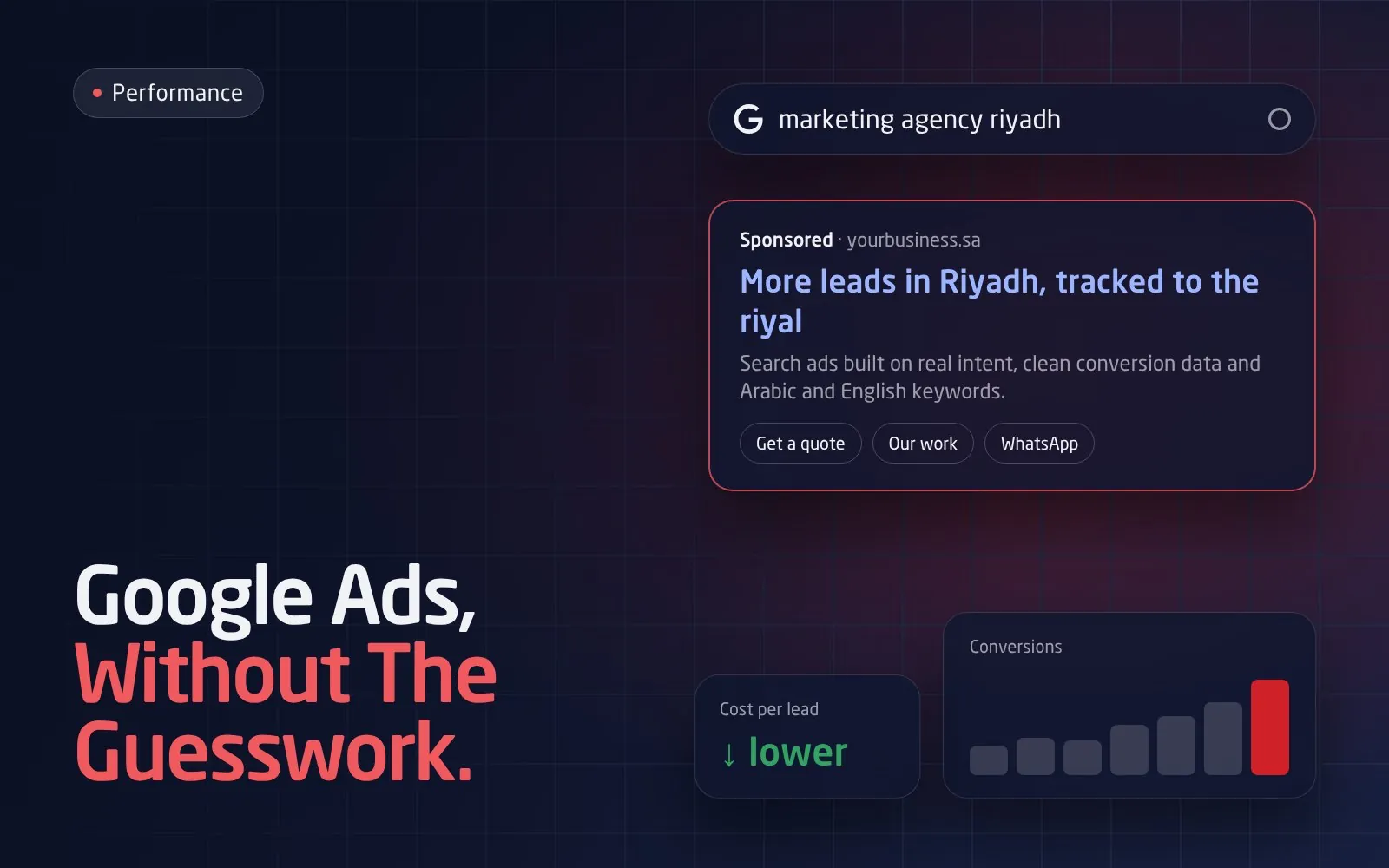
Google Ads is Google's advertising platform: your ads appear on Search, YouTube, Maps, Gmail and partner sites and apps. On Search you usually pay only per click. The big difference from social ads is intent: people are already looking for what you sell.
In Saudi Arabia that audience is large. DataReportal counts 34.4 million internet users at the end of 2025, with online penetration at 99.0 percent, and reports that YouTube ads reached 27.5 million users in late 2025 (Digital 2026: Saudi Arabia).
Google Ads tends to suit a business when:
- People already search for your product or service: a clinic, a contractor, a restaurant, a software tool, a product you sell online.
- You can answer that search with a clear page: services or packages, location, and a booking or contact button.
- You can track what happens after the click, such as a form, a call, a WhatsApp message or a purchase.
- You can run campaigns long enough to learn, not for one week.
It suits less well when nobody searches for your category yet. A new concept needs awareness first, through YouTube, Demand Gen or social platforms.
Campaign Types and Which Goal Each Fits
Google sets out its campaign types in Choose the right campaign type. In practice:
- Search: text ads on Google results for people actively searching. The starting point for leads, bookings and sales for most businesses.
- Performance Max: one goal-based campaign that reaches all Google Ads inventory, using Google AI and Smart Bidding. It works best when conversion tracking is solid and you can supply good images, videos and text.
- YouTube (Video): video ads for awareness or conversions, useful when a product needs explaining.
- Display: image ads across websites and apps, for reach and for reminding past visitors.
- Demand Gen: visual ads on YouTube, Discover and Gmail, built to create interest among people who are not searching yet.
- Calls: if your business runs on the phone, a call asset adds your number to Search ads so mobile users can tap to call. Google is phasing out call-only ads, so call assets on standard Search ads are now the main route.
A sensible order: start with Search on high-intent terms, prove the numbers, then add Performance Max, YouTube or Demand Gen.
Keywords and Match Types
Keywords tell Google which searches your ads may appear on. Google offers three keyword matching options:
- Broad match: the default. Ads can show on related searches, even ones without your exact words. Google stresses using it with Smart Bidding.
- Phrase match ("dental clinic riyadh"): searches that include the meaning of your keyword.
- Exact match ([dental clinic riyadh]): searches with the same meaning or intent. The most control and the least reach.
Negative keywords stop your ads showing on searches you do not want, such as "jobs", "free" or "course" for a business that offers none of these.
Arabic, English and Saudi Spellings
Arabic search terms vary a lot, and missing them wastes money or demand:
- With and without hamza: "اعلانات" and "إعلانات", "افضل" and "أفضل".
- Taa marbuta and haa: "عيادة" and "عياده".
- Saudi dialect words: "ابي" or "ابغى" for "I want", "جوال" for mobile, "كم سعر" for "how much".
- English and mixed searches, often with a city name: "clinic riyadh" or "best cafe jeddah".
Build separate Arabic and English ad groups or campaigns, so each searcher sees an ad and a page in their language. Review the search terms report weekly and add negatives and keywords from real searches.
Budget and Bidding, Without the Guesswork
There is no fixed price for a click. Each time someone searches, Google runs an auction. According to How the Google Ads auction works, six main factors decide which ads show and in what order: your bid, the quality of your ad and landing page, the expected impact of assets such as phone numbers and extra links, Ad Rank thresholds, the context of the search (location, device, time and more) and auction competitiveness. Google also notes that what you actually pay is often less than your maximum bid.
So a better ad and page can win positions at a lower cost. Google's Quality Score helps you see where you stand: a diagnostic from 1 to 10 for each keyword, built from expected clickthrough rate, ad relevance and landing page experience. Google is clear that Quality Score itself is not an input in the auction, but the quality it reflects is what counts.
On bidding:
- Start with a daily budget you can hold for several weeks, so the campaign has time to learn.
- Use Smart Bidding (Maximize conversions, then a target cost per acquisition once you have data) only when conversion tracking is reliable. Otherwise Google optimises towards the wrong thing.
- Spread the budget by priority: core Search terms first, then expansion.
How much to spend depends on your market, your competitors and what a customer is worth to you, so agree a target cost per conversion rather than borrowing another business's figure.
Set Up Conversion Tracking First
Without tracking you buy clicks, not results. Before launch:
- GA4 and Google Tag Manager: install the Google tag through Tag Manager, link GA4 to Google Ads and mark the actions that matter as key events.
- Forms and purchases: track the thank you page or the form submit event, and pass the purchase value for online stores.
- Calls: track calls from your ads and taps on the phone number on your website.
- WhatsApp clicks: many Saudi enquiries go straight to WhatsApp. Track clicks on WhatsApp buttons and wa.me links as a conversion in Tag Manager.
- Enhanced conversions: these add hashed first-party data, such as the email or phone number a customer enters, to make measurement more accurate. The data is hashed with SHA256 before it is sent (About enhanced conversions). A separate version covers leads that you close offline.
Choose one or two primary conversions per campaign. Counting page views as conversions flatters reports, not results.
Landing Pages in Arabic and English
Your page is half of the result. A good landing page:
- Matches the search: a "teeth whitening" ad goes to the whitening page.
- Loads fast on mobile.
- Shows the essentials straight away: what you offer, where, and a clear call or WhatsApp button.
- Has a proper Arabic version written for Arabic readers, right to left, not a machine translation, and an English version for English searches.
- Builds trust with real reviews and a visible location.
Common Mistakes
- Launching without conversion tracking, or tracking the wrong action.
- Relying on broad match alone, with no negative keywords and no search terms review.
- Sending every ad to the home page.
- Arabic ads that lead to an English page, or the reverse.
- Ignoring spelling variations and dialect.
- Changing budgets and bids daily, so the campaign never settles.
- Judging results by clicks and impressions instead of leads, sales and cost per result.
How to Measure Success
Measure against business numbers:
- Cost per conversion (lead, booking, purchase) and how it moves over time.
- Conversion rate from click to result.
- Return on ad spend for online stores.
- Lead quality: how many leads become customers, fed back into Google Ads where possible.
- Search impression share on your core terms, to see how much demand you are missing.
As an example of what a well-built account can reach, one Google Ads account we manage has delivered 334,000 conversions at an average of 1.50 SAR per conversion. Results vary by business and market, but the structure is the same: tracking first, tight keywords, matching pages and patient optimisation.
When to Hire an Agency
Running a small, simple account yourself can work. Consider an agency when:
- You spend enough that wasted clicks hurt.
- You need Arabic and English campaigns, tracking and landing pages built together.
- You want Search, Performance Max and YouTube to work as one plan.
- You have no time for weekly reviews and testing.
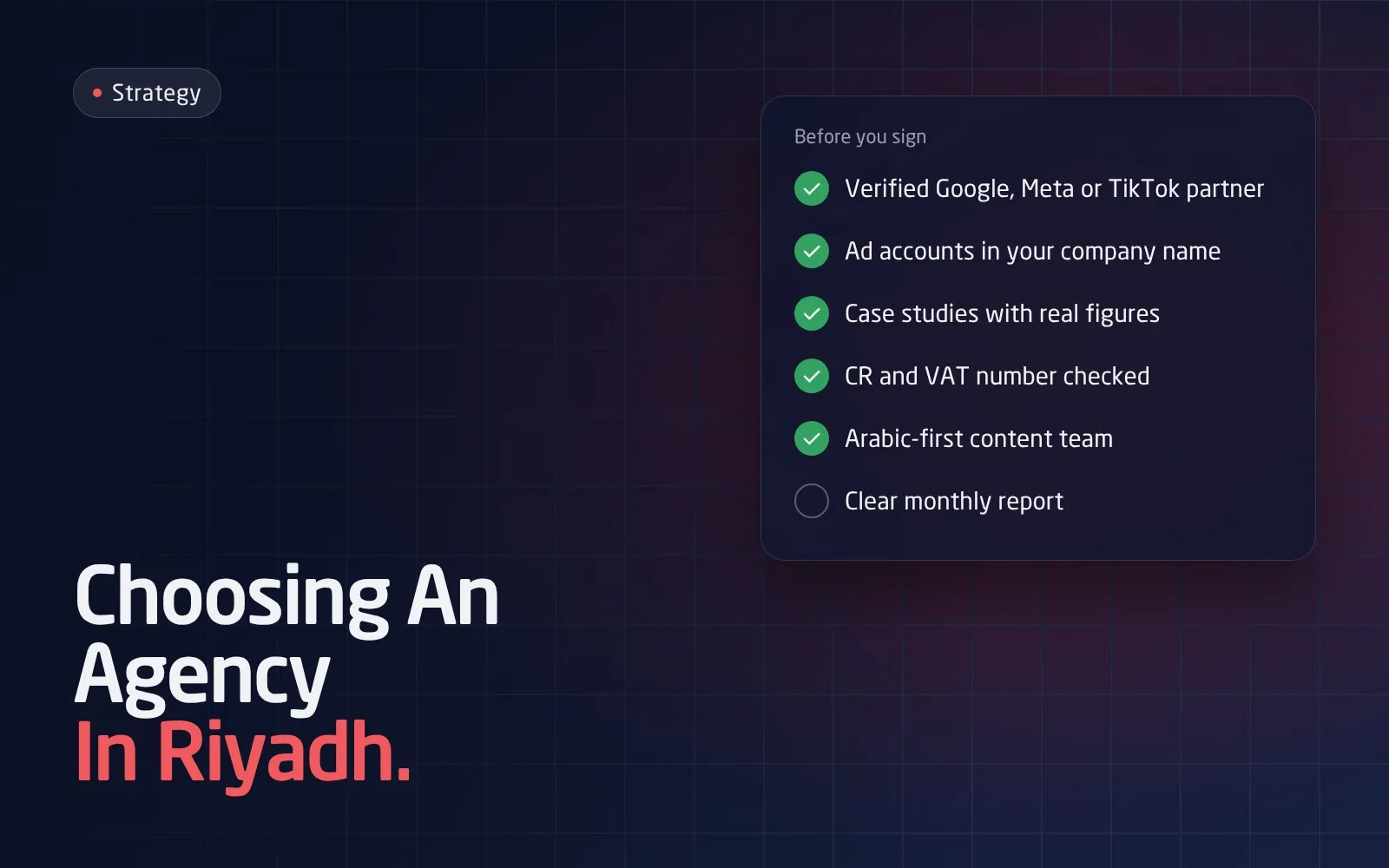
Ask any agency whose name the ad account is in (it should be yours) and what they report monthly.
Karaz is an official Google partner based in Riyadh, with a bilingual in-house team that builds the campaigns, the tracking and the pages, and your ad account stays in your name. See our digital marketing service, or contact us for a short call. Pricing depends on scope, and we send a clear written proposal after the call.